Dream template
Dream Journal Template: What to Record Each Morning
A free template you can copy, download or print, with a filled example and a simple way to use it in the app.
A useful dream journal entry preserves what you remember before you decide what it means. You do not need a complete plot, a dramatic symbol or a theory. A place, an emotion and an honest gap can be enough to compare with another morning.
Copy the morning entry template
Start with the first few fields while the memory is available. Leave the reflection section until later. You can use the same layout in a notebook, Apple Notes, another text editor or a typed dream entry.
Free template
DREAM JOURNAL — MORNING ENTRY
Date / waking time:
Title (add after capture):
Last scene or fragment:
What happened, in the order I remember:
People / places / sensory details:
Emotion in the dream:
Emotion after waking:
Uncertain or missing details:

LATER REFLECTION — KEEP SEPARATE FROM THE MEMORY
Possible waking context:
One question to explore:
Similar entry / what changed:
One detail to revisit this week:

A fragment is enough. Leave blanks rather than inventing details.
Select the text to copy it, or open the printable sheet and use your browser’s Print command. No sign-up needed.
A filled entry: the station with no trains
Fictional example. This is an editorial demonstration, not a user’s private journal or an AI-generated result.
- Date / waking time
- Example morning, 07:10.
- Title
- The station with no trains.
- Last scene
- A departure board changed every time I looked up.
- What happened
- I walked through a station looking for platform four. A friend held a yellow bag. The signs changed and I could not find a train. I woke before reaching the platform.
- People / sensory details
- A familiar friend, a yellow bag, bright signs. I do not remember any station announcements.
- Emotion in the dream / after waking
- Hurried / relieved.
- Uncertain details
- I think it was a station, but some corridors looked like my old school. I do not remember the friend’s words.
- Later reflection
- I have a deadline this week. That may be relevant to the urgency, but it does not establish what the dream means.
- One question
- Did I feel worried about being late, or about not knowing where to go?
How much detail belongs in an entry?
Use two passes. In the first, capture the last scene, what happened and the emotion. In the second, add names, sensory details and context that you still remember. Mark any detail you only guessed later. “Maybe a school” preserves more honest information than rewriting it as a certain location.
If you recall only a fragment, this is a complete enough entry: “Blue corridor; searching for someone; woke uneasy; no ending recalled.” If you recall nothing, record that and your waking mood. You can add a later memory with a note about when it returned.
Use the template in Dream Journal AI
- Open the journal and choose the recording action. Allow microphone and speech recognition access when prompted.
- Tap the microphone and describe what you remember. If speaking is inconvenient, choose Type your dream instead.
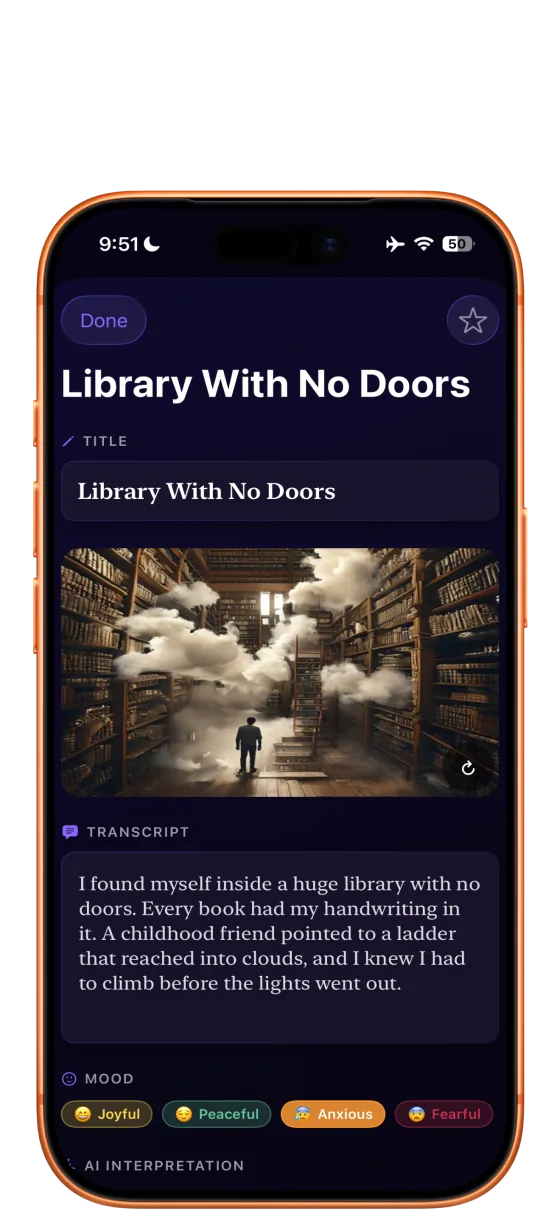
- Stop recording and open the saved entry. Review its title, transcript and mood tags; AI suggestions can be incomplete or wrong.
- Correct the transcript to match your memory. Keep any later explanation clearly labelled as reflection.
The app has an editable transcript rather than a form with these exact fields. Paste the template into a typed entry and fill only the lines you need, or use the headings as a speaking script. The generated title and tags are suggestions; keep the original remembered details in the transcript.
Review entries without forcing a pattern
Once a week, choose two or three entries. Compare both similarities and differences: did the setting recur, did the emotion change, or did you make a different choice? Keep a possible connection as a question. Two station dreams do not prove that a station has one fixed meaning.
If you want help getting started, use the seven-day routine. If a field feels blank, choose a question from the 30 recall and reflection prompts.
Dream interpretation is personal and uncertain. These resources support journaling and reflection.